June 07, 2026
The Stack Is Moving Closer to the Work
Developer tools are becoming less like destinations and more like operating layers: routers, tunnels, simulators, skills, local workspaces, and learning loops that sit around the actual work.
This week’s bookmarks had a strong through-line: developer tools are becoming less like destinations and more like operating layers. The interesting products were not just “AI assistants” or “open-source apps.” They were routers, tunnels, simulators, skills, local workspaces, and learning loops that sit around the actual work and make it cheaper, more visible, more private, or easier to verify.
That feels like the shape of the current moment. The model is only one part of the stack now. The rest is orchestration.
AI Coding Has a Cost-Shaping Layer Now
Noah Fradin’s NerfGuard announcement is a good example of where AI coding is heading. The claim is blunt: they built a tool that increased Claude Code and Codex usage by 3x “with the same spend.” In the follow-up, he says they trained a fast classifier that routes software engineering tasks to the least expensive model and reasoning depth likely to handle the job, completing classification in under 200ms.
The specific multiplier may or may not generalize, but the direction is more important than the number. Once teams use agents all day, “which model should handle this turn?” becomes infrastructure. It is no longer enough to ask whether Claude, Codex, or another tool is best overall. The more practical question is whether a given subtask needs the expensive path: high reasoning, large context, frontier model, long-running loop. Many tasks probably do not.
This also explains why 0xSero’s stack bookmark puts Tailscale, VibeProxy, and Codex App next to each other. Tailscale gives secure reachability across machines. VibeProxy, as described in the tweet, promises a single API across AI subscriptions and agents. Codex is the work surface. The pattern is clear: serious AI usage quickly creates a need for private networking, provider abstraction, and spend-aware routing.
The AI toolchain is starting to look less like “pick an app” and more like “compose a control plane.”
The iOS Loop Is Becoming Agent-Addressable
The OpenAI Developers bookmark about the Build iOS Apps plugin for Codex points at another important shift: agents need to see and operate the software they are changing. For web apps, that loop is already familiar. Run a dev server, inspect the page, click around, observe errors, patch, repeat. iOS has historically been harder because the simulator is tied to a local graphical environment and Xcode’s tooling assumptions.
The Codex plugin claims to bring more of that loop into Codex: viewing and testing an iOS app in the in-app browser, opening SwiftUI previews, and hot-reloading edits. The author reply credits two open-source projects: serve-sim, which describes itself as “the npx serve of Apple Simulators” and streams/control simulators through a browser, and SnapshotPreviews, which extracts automatic snapshots from Xcode previews across Apple platforms.
Then there is Baguette, a separate project recommended as another remote-access option. Its site describes a Swift CLI that boots iOS simulators headlessly, streams them at 60fps, injects taps and gestures, and exposes a multi-device farm dashboard: tddworks.github.io/baguette.
The point is not that every developer suddenly needs an iOS simulator in a browser. The point is that UI runtime access is becoming part of the agent contract. If an agent can edit code but cannot observe the app behaving, it is still partly blind. The strongest workflows will make test surfaces, previews, logs, and device interaction available as ordinary tool calls.
Skills Are Becoming Reusable Judgment, Not Just Prompts
Two bookmarks were about Codex or Claude “skills,” but they were interesting for different reasons.
The first is the Codex Security Audit Skill, which promises a production-readiness audit for common MVP risks: exposed secrets, auth and authorization mistakes, client-side gates, CORS, headers, rate limits, uploads, webhooks, payments, and dependencies. The linked page describes it as a practical security audit skill for codebases, SaaS apps, APIs, and MVPs, with source on GitHub.
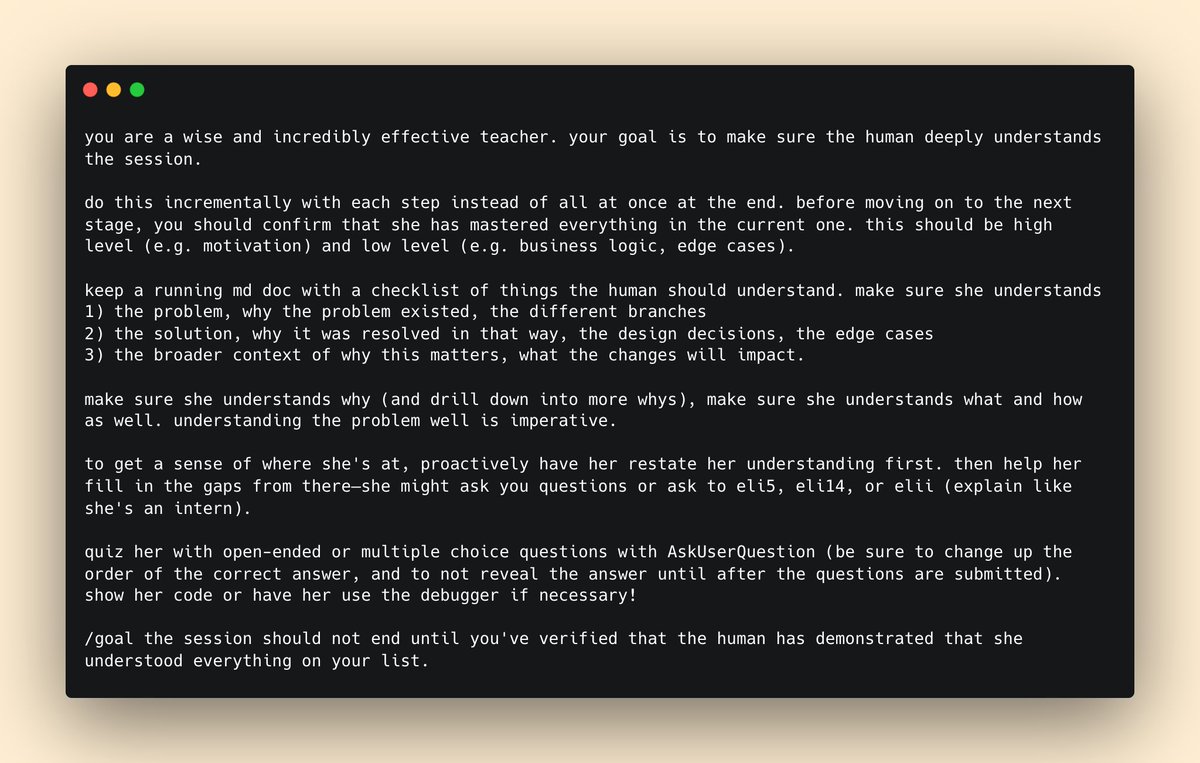
The second is Thariq’s bookmark about staying “in the loop” with Claude’s work, linking to a gist called “Learn Quiz”. The prompt reframes the agent as a teacher: keep a running checklist of what the human should understand, explain incrementally, ask the human to restate understanding, and quiz them before moving on. The most useful line in the gist’s discussion is not from the original prompt but from a commenter’s adaptation: “make the human’s understanding a first-class deliverable.”
That is a strong framing for agent workflows. Skills are often treated as clever prompt packs, but the better abstraction is reusable operational judgment. One skill encodes what a launch security review should notice. Another encodes how to keep the operator from becoming detached from a long agent session. Both are responses to the same problem: agents make it easier to move fast, but moving fast without review, context, or comprehension creates new failure modes.
Open Source Is Reclaiming the Device and the Workspace
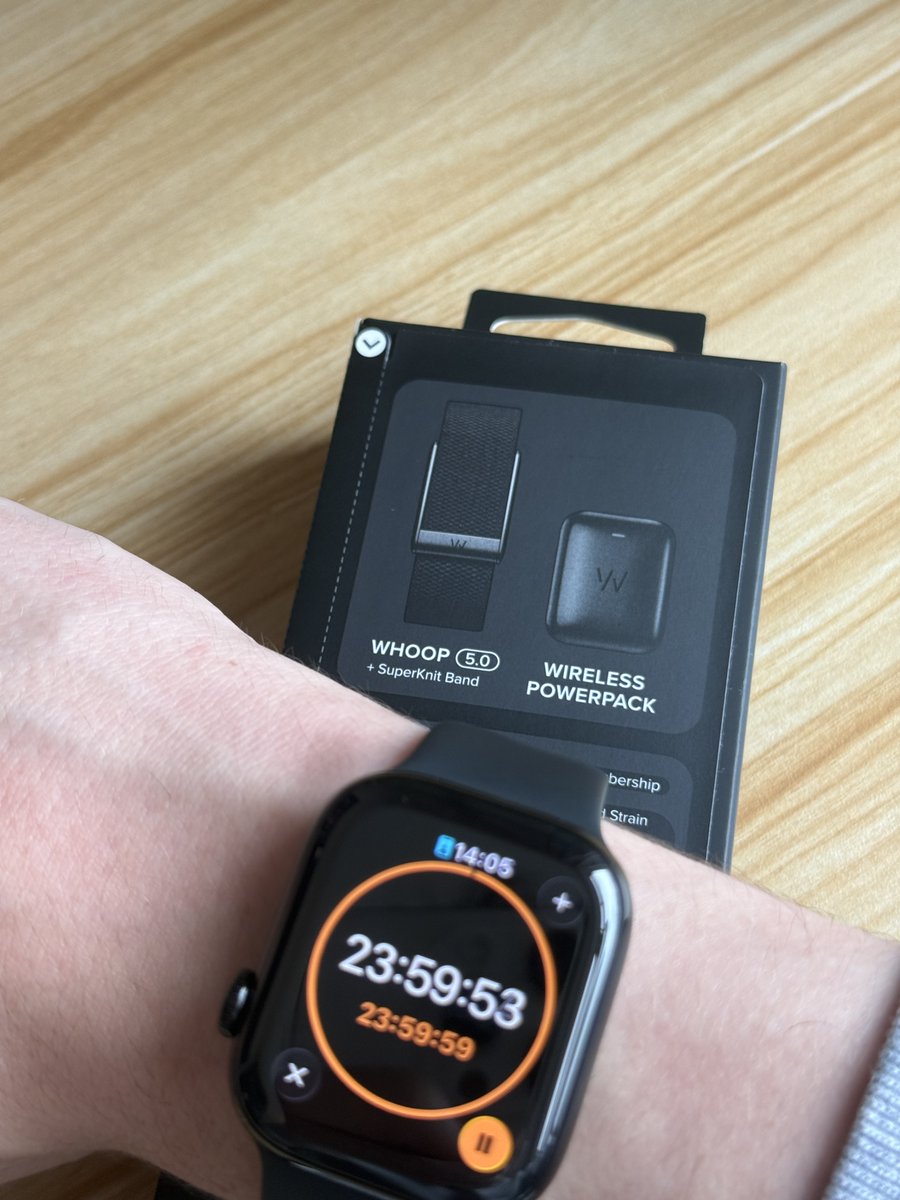
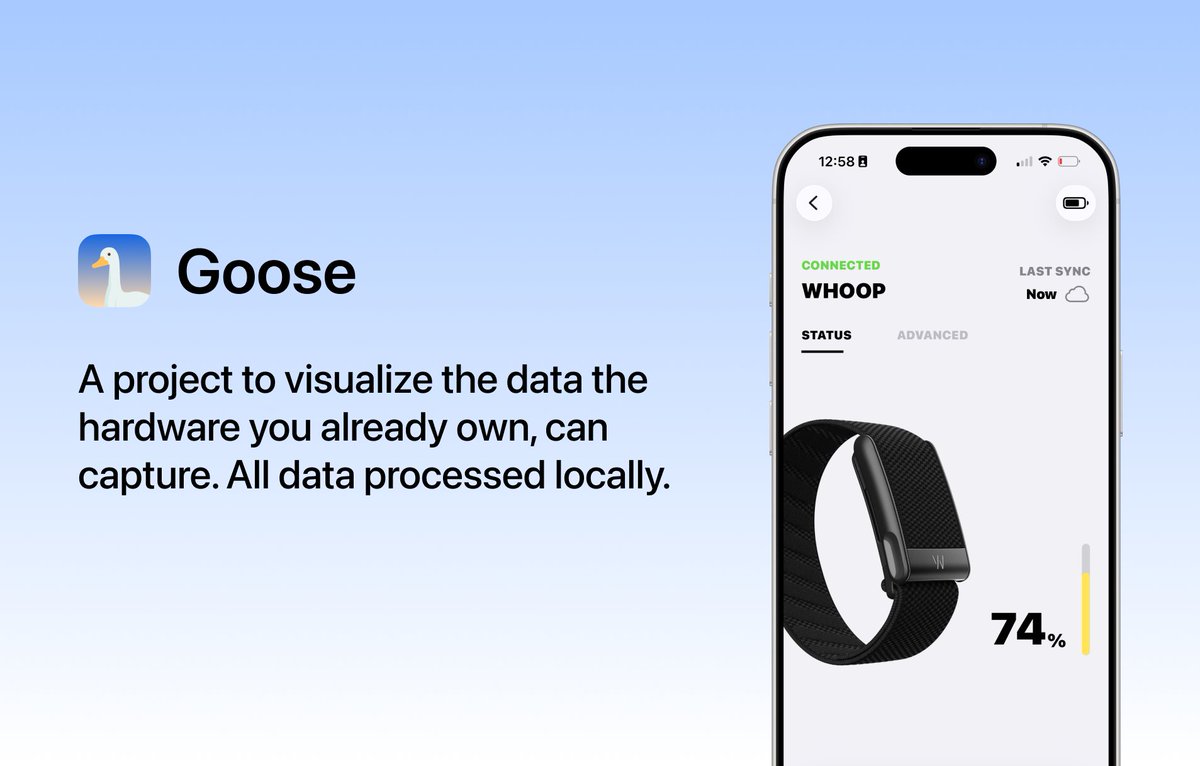
The most hackerish bookmark was Bennet’s WHOOP 5.0 reverse-engineering sprint. In under a day, he shared an open-source app called Goose, described in the README as an alpha proof of concept for developers. It targets WHOOP 5.0 only, connects to the band over Bluetooth, routes packet data through a Rust core, and exposes health, recovery, sleep, strain, stress, cardio, coach, and debug views. The README is careful that it is independent, unaffiliated with WHOOP, not ready for personal health tracking, and not a drop-in replacement.
That caveat matters. Health data is not a toy domain. But the project is still notable because it pushes against a common product boundary: the hardware is on your body, but the useful software path is subscription-mediated. Goose is an early developer artifact, not a consumer replacement, yet it captures the appetite for local-first access to owned devices.
The same energy shows up in the bookmark about PewDiePie open-sourcing a self-hosted AI workspace. The project appears to be Odysseus, whose README describes a self-hosted AI workspace meant to provide a ChatGPT/Claude-like UI on your own hardware, with local-first privacy and support for chat, agents, tools, MCP, memory, email, deep research, compare mode, documents, notes, and tasks. The project site says it runs against your own endpoints with no telemetry and optional external integrations: pewdiepie-archdaemon.github.io/odysseus.
Odysseus is interesting partly because of the celebrity distribution, but it should not be dismissed as just celebrity distribution. Its popularity suggests that “self-hosted AI workspace” is a legible category now. People understand the trade: more setup and rougher edges in exchange for privacy, control, local data, and model choice.
London Keeps Pulling AI Infrastructure Toward It
The Runway bookmark is more ecosystem-level, but it fits the week. Anastasis Germanidis announced that Runway is making London its European HQ, saying the London team has become central to research including work on GWM-1, Runway’s general world model. The quoted political post claimed more than $200 million of UK investment; The Next Web reported that Runway picked London for its European headquarters and pledged more than $200 million into the UK AI ecosystem by the end of 2028.
This matters because AI geography is also becoming stack geography. Research labs, model companies, infra startups, design talent, policy people, and customers tend to compound around each other. A world-model company choosing London as its European base is another small signal that the UK is trying to be more than a satellite market for US AI products.
The common thread across all these bookmarks is agency moving closer to the developer: route the model, tunnel the machine, drive the simulator, audit the repo, teach the human, read the device, host the workspace. The tooling is becoming more intimate with the work and more explicit about the systems around it.
The next bottleneck may not be model quality. It may be whether the surrounding stack helps us spend attention, compute, money, and trust in the right places.
Source Trail
- 0xSero on Tailscale, VibeProxy, and Codex App
- Noah Fradin announcing NerfGuard and nerfguard.com
- OpenAI Developers on the iOS app loop in Codex
- serve-sim GitHub repo
- SnapshotPreviews GitHub repo
- Baguette tweet and Baguette project site
- Codex Security Audit Skill tweet, project page, and GitHub repo
- Thariq on staying in the loop with Claude and Learn Quiz gist
- Bennet’s Goose announcement and Goose GitHub repo
- PewDiePie/Odysseus bookmark, Odysseus GitHub repo, and Odysseus project site
- Runway London announcement tweet and The Next Web report
Bookmarked sources
Original context
@0xSero · Sat Jun 06
Most important software in my stack: #1 Tailscale - SSH into all your devices securely - Host websites for use in your home network - Easy high quality VPN #2 VibeProxy - Connect all your AI subscriptions - Single API which will connect to any agent #3 Codex App - Fire
@noahfradin · Fri Jun 05
We built a tool to increase our Claude Code and Codex usage by 3x with the same spend. https://t.co/vqdSkxK0bk It also saves us hours a day per person in time we’d otherwise be waiting around for model generation time. Today we're sharing it with the community.
@itshanrw · Fri Jun 05
Here’s another option: https://t.co/9poLBRhUgM. It’s optimized specifically for remote access while maintaining usage very similar to the native iOS simulator. Every key press, as well as edge screen gestures like pull-down and swipe-up, are fully supported. It’s especially suitable for remote app development, making testing easy and responsive with very low latency. Highly recommended for remote debugging and validation.
Quoted tweet
@OpenAIDevs: More of the iOS app loop, now inside Codex. The Build iOS Apps plugin lets Codex view and test your iOS app in the in-app browser, open SwiftUI previews, and hot reload edits without leaving Codex. https://t.co/SksapiJFjY
@Kappaemme1926 · Thu Jun 04
CODEX SKILL TO BRUTALLY AUDIT YOUR APP BEFORE LAUNCH! Most MVPs look fine locally. This Codex skill tells you what could actually break in production. Just point Codex at your repo and it security-audits it for you -> scans for exposed secrets -> checks auth and authorization risks -> finds unsafe client-side gates -> reviews API, CORS, headers, and rate limits -> flags upload, webhook, payment, and dependency risks -> gives you a prioritized fix plan before launch Install: `npx --yes codex-security-audit-skill@latest` 100% open source. Link in bio.
@OpenAIDevs · Thu Jun 04
More of the iOS app loop, now inside Codex. The Build iOS Apps plugin lets Codex view and test your iOS app in the in-app browser, open SwiftUI previews, and hot reload edits without leaving Codex. https://t.co/SksapiJFjY
@b_nnett · Tue Jun 02
23.5 hours later... there's an app and it's open source. It tracks activities & sleep. It has full sensor support: HR, SpO2, HRV, Temperature, Motion, etc. https://t.co/vbIpH4AUnL
Quoted tweet
@b_nnett: Reverse-engineering the Whoop 5.0 to work without a subscription in 24 hours. Starting now. https://t.co/xnPxex916L
@trq212 · Mon Jun 01
been asking others at Anthropic how they stay in the loop with Claude and fully understand the work being done this is one of my favorites from Suzanne: https://t.co/nqIMcGXiKI
@agermanidis · Mon Jun 01
Today we’re announcing London as Runway’s European HQ, and doubling down on our investment in the UK AI ecosystem. In under two years, our London team has become central to our research, including foundational work on GWM-1, our latest general world model. The caliber of talent and industry presence here makes it an ideal environment for the next chapter of Runway’s growth and for shaping the next generation of AI with world simulation. I’ll be in London for the week; DM me if you want to meet up!
Quoted tweet
@SebJohnsonUK: ANOTHER big AI Lab is massively investing in London. This time it is @runwayml - the Nvidia backed world world provider. It has just announced plans to make London its new European headquarters and will invest more than $200 million into the U.K. @KanishkaNarayan, the https://t.co/fTBAJJIphn
@Hesamation · Mon Jun 01
Pewd did it again. now he open-sourced a self-hosted AI workspace. bro is building a CV harder than a CS undergrad looking for a job: > built a 10-GPU home rig > quantized giant LLM to run local > built ChatOS, local AI UI > added RAG/local memory > built “council” of AI models > built “swarm”, small models in parallel for data collection > fine-tuned a Qwen 32B-based coding model > donated compute from his GPU rig for protein folding research

Private feedback
Curation notes
Visible only on localhost. These notes and bookmark ratings are saved locally and included in the next writing prompt.